Prepping, homesteading and living the simple, green, independent life.
Showing posts with label self-sufficiency. Show all posts

Saturday, October 30, 2010

Food Dehydrating Fun!

A few weeks ago I received my Excalibur dehydrator in the mail. I bought a refurbished model with a 10 year warranty for $160 at the companies website (they're regularly over $200) but shipping was another $56 and duty was $27. I'd recommend looking into the Canadian supplier, Basic Life Essentials, to lower shipping and avoid duty taxes. You can also order them from Amazon.

There are less expensive dehydrator brands out there but if you want to seriously get into dehydrating as a way of preserving and storing food I'd go for an Excalibur. I used to have one of the smaller less expensive models. They're good for trying out dehydrating and making a few snacks but f you want to dehydrate a bushel of apples that you pick up on sale at a farmers market or do a whole 10 pound bag of potatoes you'll need the Excalibur. The other models aren't large enough and it would literally take a week to dry all those apples or potatoes. For this reason I'd also recommend getting the 9 tray Excalibur instead I'd the 4 tray model if you can afford it.

I've been trying out tons of different foods in the dehydrator and so far I'm pretty impressed. You can eat the foods dry themselves or rehydrate them to use in meals. When you dehydrate the food the texture is never the same as fresh but that's okay if your using them in stews, soups etc.. To rehydrated them I boil the dried food for a few minutes. You can also steam your veggies to rehydrate them.


(Above: dried tomato, red /green peppers, celery, mushrooms, broccoli, potatoes and my assistant)

The dried peppers in my homemade salsa are pretty good. The potatoes are excellent pan fried or in a stew but they're too thick and slimy mashed. Rehydrated apples in an apple crisp are also really good.  Tomatoes come out soft but are good for soups.  As for broccoli, the stems get too tough so just dehydrate the tops. I haven't done onions or garlic yet because supposedly they really stink up the house and it's too cold to open the windows to ventilate.

My general idea is to buy veggies on sale and dehydrate them so they'll last a long time. I got a bunch of mason jars for my birthday and bought oxygen absorbers from that Canadian supplier I mentioned above. If I put the dried food in the jars with the O2 absorber it should last at least a year though various sources claim they'll last up to 5 even 30 years! Personally 5 years seems the limit to me and after 2 years I'd be wary.

The website Dehydrate 2 Store is a great resource with tons of recipies, tips and how-too videos.  The book "The Dehydrator Bible" also has a lot of great tips and recipes which is where I found my recipe for apple crisp.

I'm learning that there are a lot of different methods and recommendations out there so if you want to get into dehydrating try different things and have fun experimenting!

Wednesday, September 1, 2010

You Know You're Getting Old When...

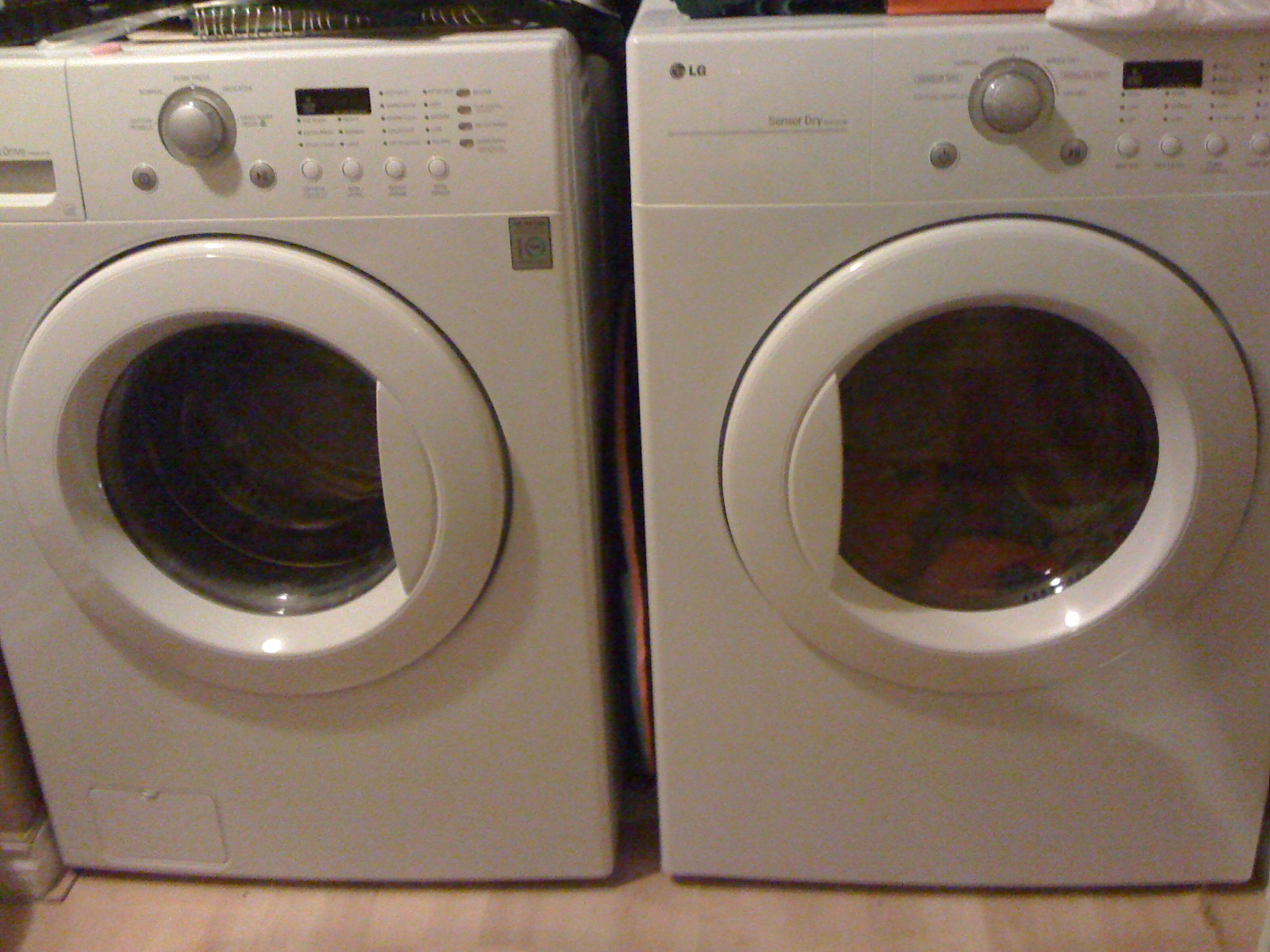
A few weeks back we received our new high-efficiency front loading LG washer and dryer set and I have to say, I'm pretty impressed by them.
 
The set was only around $1000 (on sale) but I felt like I'd gone from a Chevette to a Cadillac when compared to our old set.  A cute little luxury feature is that they play a little song when a load is done.  I told my wife I've always dreamed of having a somebody who loved housework so much that it sang to her.
 
The washer is very efficient at conserving water.  In fact, at first we weren't sure if we hooked it up properly because we couldn't see any water through the glass door.  It turns out that the machine weighs how much clothes are in it and only uses enough water to soak the clothes. I'm very curious to see how this affects our next water bill because I estimate we've gone from using approx. 20 litres a load to maybe only 4 or 5.
 
Although these style of washer do take longer to clean a load (about an hour), we can do much larger loads so the time spent works out to about the same.
 
Another thing that's great about the washer is that it spin-dries the clothes so well that they come out of the washer just damp and almost dry.  Sometimes I have to think twice if a load has even gone through the washer since so much water is removed. 
 
As for the dryer, I'm a little disappointed that it was rated as only average when it comes to energy use, however we're noticing that most loads get dried in under 25 minutes. Not only does the washer do such a great time spin-drying, but the dryer also has a sensor that can tell when the clothes are dry and it will shut itself off.  Very often the timer will show 30 minutes or so left but then a couple minutes later it shuts off because the clothes are dry!
 
In a few years time, after we build our next house, I'd like to look into getting a similar style propane or natural gas dryer.  This would really reduce our energy use.  Sure we could use a clothesline to dry our clothes, we used to and probably will again some day, but with two little kids it's much easier to just use the dryer.
 
On the "luxury" side of things I'm impressed by how huge the interior of the dryer is and it's kinda neat to have a light inside it.
 
So far the only minor downside to these is that I find we have to remember to leave the washer door open to allow it to dry out.  The front loading door is water/air tight and I've noticed that if we forget to leave the door open it is still damp inside days later.  I'm afraid that this could lead to a musty smell and maybe mold which probably explains why the washer has a "self-cleaning" feature.
 
We're pretty happy with our new washer and dryer set but also a little depressed.  When you reach the stage that the most exciting thing in your life is your new washer and dryer you know you're getting old!

Thursday, June 17, 2010

Pioneer Solar: PV System For Free?

I received a flyer from Pioneer Solar in the mail the other day which claims to help people get a solar system installed on their house, farm, or business for free. Sounds too good to be true, right?

Well, like most things there's good and bad points about it and what might be a good deal for one person might not for another.

Here's how it works:

The Ontario government recently started a program where homes and businesses / farms that install solar or wind power will be paid a guaranteed rate per kilowatt for a 20 year contract.

What Pioneer Solar does is install the PV system for "free" but for the first 10 years, the money you're paid by the government for the electricity goes to Pioneer Solar.  You get to keep the revenue from the 10 years left in your contract with the government though.


The example in the flyer states:

Solar System Earnings / Month = $840
Solar Finance Payment               = $780
---------------------------------------------------
Initial Monthly Earnings            = $60
Eventual Monthly Earnings       = $800 (after 10 years)


They're promoting it as an investment that's better than stocks.  One way of looking at this is that you'll eventually be earning a monthly income with no initial investment.

However, using the figures from the flyer this means that you'll have paid over $93 000 for the PV system.

From all the research I've done I estimate that a PV system large enough to power a modern but energy efficient home, would cost between $25 000 and $35 000 to professionally install.  If you do it yourself it's could be half of that and you don't need Pioneer Solar to apply for a 20 year government energy contract.

Another downside is that all this energy produced goes to the grid and doesn't isn't actually used for your home. I assume however that once you own the solar system after 10 years, you can turn it into a hybrid system to power your house. It's possible however that the 20 year government contract may disallow this (I've written Pioneer Solar and email to clarify this).

Despite those downsides, you're still getting a PV system for "free" and making an income for at least 10 years from selling the energy.

For those who are looking to go off-grid and be a self-sustainable as possible, the prospect of waiting 10 to 20 years to use the electricity might not be worth it.  Though the income it would provide would go a lot towards becoming independent.

If you're looking to help the environment and make some money however it might be a great idea.

I know if I owned a property right now suitable for such a PV system, I'd be giving them a call.

Wednesday, May 12, 2010

Do It Yourself Home Improvement: Book Review

I love the books done by DK publishers; their books are always very informative and very visual with nice photos to help explain the topic.

This is why when I was at Costco the other week I had to pick up the book, "Do-It-Yourself Home Improvement: A Step-By-Step Guide".

My wife asked me why I needed another home improvement book but this one was different.

I've read other books in the past but often the authors assume that you have a basic knowledge or tools an terminology.  The DK book explains even the VERY basic; it even shows you how to use a screwdriver, ladder and saw!  Believe it or not a lot of people don't know the proper technique to use these basic tools which includes me!

The pictures are very helpful and explain things step by step.  I wish I had this book years ago; it could have saved me from making a lot of mistakes.

Unlike other books it also was a true Canadian version, instead of an American book with a 2 page addition for Canadians tacked on.

Another great thing is that the book includes many green and energy efficient topics for the home along with excellent photos.  I learned a lot from this book on things like rain catchment and grey water systems which until now I wasn't able to discover much about other than that they existed and were available.

I really recommend this book. It's great for not only the beginner who wants to do a few simple things around the home but also for those doing major renovations or building.
                                                                                    
                                                                                                                (Canadian version above with Link)

Wednesday, April 28, 2010

Global Warming Fail

 This is what my neighbour's yard looked like yesterday:


Luckily the side of my house that has the garden was sheltered from the snow but this has got me wondering about building cold frames for the garden.

Actual cold frames can be pretty expensive so I was thinking of using window well covers like the one on the left.  These are wedged shaped and are meant to go over a basement window so it doesn't have a back.  This would be fine for me since my garden is against my home's foundation, but for others you'd need to close off the back or use two back-to-back. 

Another idea that came to me would be too get a clear plastic storage bin of the "Rubbermaid" type.  These are less expensive than the other options but the plastic isn't very clear; though greenhouses that use 6 mil plastic vapour barrier have the same level of clarity and the plants seem to do fine in those.  Anybody have some experience with coldframes that can chime in?


Tuesday, April 20, 2010

Welcome to the Waterpik Experience!

A few days back my wife mentioned that the showerhead was getting clogged again and that we'd need to soak it in vinegar again.

Our last waterbill is still on my mind so when she told me this I thought, "What a great excuse to get a new water-saving showerhead!".

The model that had gotten blocked was a water-saving model and I had recently read that older models were prone to blocking in areas with hard water.  Newer ones also have rubber outlets so if they ever scale up you just rub them with your finger and it unblocks them and they're supposedly more efficient.

We picked up the Waterpik Ecoflow from Canadian Tire (on sale this week for only $23.)

What I really like about this one is that it has a shut-off button so you can turn the shower off without closing the faucet and losing your temperature setting.  This allows you to get wet, shut off the water, lather up and then turn the water back on to rinse off.

The package claims you'll save up to 77% water by using the shut-off button.

When my wife brought it home she wanted me to install it right away, but feeling lazy I intended to only read the instruction so I'd at least look productive.

"Welcome to the Waterpik Experience", the instructions exclaimed before assuring me that installation can be done by hand in just a few minutes.

With my aversion to physical labour satisfied and a sudden urge to see first hand the "Waterpik experience (TM)", I decided to give it a try.

The original showerhead came off easy enough, though I did need a wrench to initially loosen it.  The next step was to just screw on the new showerhead and attach it to the hose.  Pretty simple I have to say.

I turned on the shower and there was a small leak in the two connections so I used a wrench to tighten them and scratched up the plastic couplings (Grr...).

After this it was still leaking so I went back to check the instructions and noticed that the rubber washers had fallen out of the hose.

I unscrewed the showerhead and installed the washers (scratching the plastic further).  I decided to just tighten them by hand this time to see if it lived up the claim of "no tools required".

I have to say I'm pretty impressed.  It was pretty easy to install and if you do it right you probably won't need tools.  If you avoid the mistakes I did the whole process can probably be done under 5 minutes.

According to our last water bill we're looking at close to $1000 a year for water charges.  With that expense my wife and I have been talking about getting a new high-efficiency washer which would probably pay for itself in a few years.

With a new shower head, dual-flush toilets and soon a new washer we're curious to see what our next waterbill will be like!

Wednesday, April 14, 2010

The Newest Excitement In My Life: Dual-Flush Toilet!

Last week I got my quarterly municipal water bill: $240!

That's about $1000 a year I'm paying for water which dries out my skin and reeks of chlorine.

This was ample motivation for me to finally get around to installing a dual-flush adapter to our existing toilets.


I picked this thing up at Canadian Tire for around $35 and it was VERY easy to install.  All I needed was a wrench to remove the old handle; the rest just goes in by hand.


Here's what it looks like out of the box:


The blue circles on the left is the water-water saving fill valve I installed a couple weeks back.  The white part on the right is the new dual-flush adapter and the white box on the left is the button which replaces the flush-handle.

Although it was easy to install, it took me almost an hour to adjust if so the "quick flush" option worked properly, but it was well worth it.


This is what the toilet looks like now with the buttons where the handle would be:

Now it takes 6 liters to flush "solids" (same as before) but it only uses about 2 liters to flush "liquids" using the "quick flush" option.

Watching the water level drop using the quick flush it only dropped about 3 inches, about a third of the water in the tank, but that isn't the best part...

The instructions that come with this device gives you tips on how to make your toilet more efficient.  One things it recommends is cleaning out the flush jets under the rim of the bowl with a wire.  When I couldn't get the adjustment right I decided to try this out and it made a big difference.

In fact it works so well, I find that I can flush "solids" with the quick-flush option!

This means that we'll reduce our water use by over 60% and it is estimated that toilets make up 30% of water used in the average home.

Now I have mixed feelings about receiving my next water bill; I'm not looking forward to paying it but I can't wait to see how much we've reduced our water use!


Sunday, April 11, 2010

My Quick and Easy Square Foot Garden

Here's my little garden that I did last week.  It's a modified square foot garden where instead of a 4 x 4 bed this is 1 x 28.

I have a small 50x 50 lot so there isn't room for anything much larger.

The walls of the bed are plastic fake stones.  They're $15 for 9 feet at Walmart and Canadian Tire.  I got 3 of them which I figure is cheaper than the wood I was planning to make it out of. I do plan on hammering wooden stakes in the outside ground to make them a little more stable.


They were super easy to set up too; took like 20 minutes.  I put cardboard on the bottom of the bed to get rid of the grass.  After the cardboard kills off the grass it will breakdown into the soil.


I tried to use "Mel's Mix" (the fellow who developed Square Foot Gardening) of  1/3 compost, 1/3 vermiculite and 1/3 peat moss though mine is a little heavy on the peat moss.


That's peat moss on the left, vermiculite in the middle, and compost on the right.  I put it all on the tarp because not only does it keep your lawn neat, but it makes it easier to mix.  All you do is lift up each side and corner and it all rolls on top of itself.  If the tarp isn't too heavy you can just pick it all up and dump it in your garden bed.


I then used sticks around the house to mark off the one foot squares.


Each square has a different plant/vegetable.  I rotated it by root veggie/leaf veggie/herb/flower/ fruit veggie.

As you may be able to see I've got downspouts and rain barrels on each end of the garden.  I plan on installing a drip hose on them to help water the garden later.

I think I'll also install planter boxes on my front and back porches to plant more veggies and my wife is excited about putting a dwarf cherry tree in the front yard.

This is my first attempt at gardening so hopefully everything works out all right. So far it looks good because one week later I've already got radishes sprouting!

Friday, April 2, 2010

Simple Living: Getting Rid of "Stuff"

"The stuff you own, owns you."

I know that saying sounds bizarre and maybe a little paranoid but in many ways it's true.

In my the back of my mind I'm always thinking, "I have to clean up and organize; my house is too cluttered.".  It's a little thing but it's one more stress in my life and it takes time away from more important things.

Cleaning and organizing is just a temporary fix though. Eventually the "stuff" will get out of place and you have to go through the process again.  The only permanent solution is to get rid of stuff and only keep essentials (or better still, don't buy it in the first place).

Getting rid of stuff actually feels very liberating!

Not only does it make your house more tidy, but by only keeping what you truly need and use you're also evaluating your own life and thinking about what's important to you. You may think "I can't live without that", but by getting rid of stuff you're proving to yourself that you can!

My advice to get started is to go through all the storage boxes in your house.

This is why I actually love moving; you evaluate all your stuff twice over.  When you pack the moving boxes you think, "is it worth packing or should I junk it?".  Then when you unpack in your new home you tend to first unpack only the stuff you really need.

If you haven't opened a moving box after more than a year, you should really ask yourself if you truly need whatever is in that box. That also goes for any other box, bag, shelf or storage area in your home.

There are also many option to get rid of the junk besides just throwing it in the garbage:

1) Charities

Places like the Salvation Army, Goodwill or Value Village sell these used items for charity funds.  Just pack the stuff and drop it off.  Some charities will give a tax receipt for drop offs or a coupon for use in their shop and some will even come to pick up the stuff!

2) Freecycle

Freecycle is like on-line classified ads which features only free stuff. It's all done by volunteers and is usually done through email lists or online forums.  Naturally to prevent people abusing the system you're not allowed to re-sell the items you get for free.

We've gotten quite a few things through our local freecycle and it's a great way to build a sense of community.

3) Garage Sale


A little more work than the other options but at least you'll get some money out of it.  The downside though is that you'll probably still have stuff left which means you'll still have to get rid of it somehow.

Monday, March 29, 2010

Product Review: Hydroclean Water-Saving Toilet Fill Valve

The other week my wife surprised me with a gift that only a prepper could  get excited over: a dual-flush toilet retrofit!

I'm really excited to try out this gadget, however when I read the instructions I found out that it doesn't work with the "ball and lever" floater style fill valves.  I'd have to switch over my toilet first before installing it.

There are many different types of fill valves and company that makes the dual flush recommends their own which also has a water saving feature. I picked one up at Canadian Tire for around $17.

There is also a "deluxe" version for $19 that includes jets which supposedly clean the inside of your toilet tank with each flush.

Installing it was super-easy and just took around 10 minutes.  The only tool I required was a wrench to remove the old fittings, the rest is done by hand.

These things are supposed to save water through a little lever valve where you can adjust how much water goes down the refill tube and into the toilet bowl.

The instructions include a simple technique to determine the proper amount of bowl water, however I decided to try the "trial and error" method.  I placed the valve at half open and there is a noticeable difference in the amount of water in the bowl.  As far as I can tell this hasn't affected the flush and I estimate we're saving at least a liter each flush.

I'd recommend people try give this device a try, however, one thing to keep in mind is that it isn't meant to be used with those toilet pucks that you put in the back of the tanks.  The instructions don't explain why but I assume it's because the chemicals will breakdown the plastic parts.

Soon I'll get around to installing the dual-flush retrofit and I'll post the results.

Has anybody else tried these gadgets or a similar device?

Friday, March 19, 2010

Cubicles Will Be the Death of Me

My mom says that when my great-grandfather knew his time was coming he put on his boots, went out to his barn, lied down in the hay and passed away.

When my time comes where will I go?


I refuse to let it be in a soulless cubicle maze, with their temporary walls, in "business casual" with a parking garage being the last thing I see out the window.

Thursday, March 18, 2010

Setting Goals and Life Plans: Our Dream House

As I  mentioned in the last post, our plan is to begin building our dream home in 5 years or so.

Many people build their own homes though; what does this have to do with prepping and modern survivalism?

Building our own home actually involves prepping in two ways: planning for the home and living in the home.

1) Planning for the home

Part of modern survivalism is financial preparedness. By paying off debts and saving money we're moving to a position where we'll eventually be able to afford to build this home.

Secondly the things we're doing now are preparing us to live there.  For example, I'm reducing our electrical use because I want our dream home to eventually be off-grid.  Getting us used to energy conservation now will help us adapt to our new home.

Currently we use about 1200KW a month, but in our new energy efficient home I estimate that we will use between 5-700KW.  Amazingly, despite being a larger home with more gadgets, thanks to energy efficiencies our needs will be less.

My family and friends might think I'm nuts obsessing over things like CFL bulbs, my small vegetable garden and organic lawn care but they don't see the big picture.  Each one of those things are little preparedness steps to freedom!


2) Living in the home

Once we build and start living in this dream home I'm hoping to start living the prepper dream!

I don't think I've clearly stated it before but I'm hoping this new house can become a "homestead" that will provide for most of our needs: electricity, heat, food, water.

Electricity:

By being super-energy efficient my goal at first is to greatly reduce utility expenses.  Eventually I'll upgrade the system with so we'll be able to comfortably live during a winter power blackout and hopefully eventually reach the point where we can live off-grid.

For budget reasons I plan on starting with a minimum of 5 165W solar panels tied to the grid.  Over time I'll add more panels and a battery bank so we can have power during blackouts.  We'll also look into if a windmill generator is feasible.  Eventually I'd like to be able to live off-grid so we won't cut off the grid totally  because in case of emergencies it can be our backup.

Secondly, if we do things right we'll actually be able to make money by selling excess electricity to the grid!

We'll also save a lot of electricity by switching our stove, fridge and dryer to ultra-efficient propane models and cooking when I can with a solar oven.  If I can convince my wife, we'll cook with an old-style kitchen woodstove (but with modern technology) to be truly off-grid.


Heat:

For a number of reasons I want a minimum of 4 acres for our dream homestead.  One of these reason is because we want to install geothermal heat exchange to heat our home and water.  The pipes used in this system are often installed horizontally beneath the frost-line so we'll need room to do this.  The pipes can also be installed vertically but we don't want to limit ourselves to one option.

Geothermal is very energy efficient however it needs electricity to operate the heat pump so we'll include a wood stove as a back up source of heat for on the very cold nights or when the power goes out. Hopefully much of our wood will come from our own property.  Another great thing about geothermal is that it can also be used to efficiently cool your house in the summer by just reversing the pump!

Heating our water will be done using an instant-on tankless water heater.  Geothermal will also be used to pre-heat the water to further reduce the energy use.  I'll also look into solar water heating, especially for the planned indoor pool/sunroom.  It's possible that solar heating and geothermal could provide most of our hot water apart from the coldest winter months!

Lastly, we plan on building our home with Insulated Concrete Forms.  There are kinda like big styrofoam Lego-blocks that you build a home with.  After you make a wall with them they're filled with concrete.  This makes a very sturdy and energy efficient structure, (also water/air-tight, bulletproof, fireproof and hurricane/zombie resistant). With an R-Value of 45  ICFs will greatly reduce our energy needs.

Food:

I'm currently learning all I can about organic gardening and permaculture.  I don't knock those that use fertilizer and weed chemicals, however, to me that seems like a lot of work that you have to do every year.  I'd rather do it all naturally and although it might not look as pretty, at least it will be self-sustaining and low-maintenance.

My plan includes, a small orchard, a greenhouse, a number of raised bed squarefoot gardens, a goat to "mow" the grass and possibly milk and maybe chickens and bees.

With enough acres I could also start hunting or allow other to hunt there in exchange for some of their game.

These won't be enough for us to live completely off of but every little bit is less that I have to rely on the grocery store for and less sales taxes to the government.  It all equals more money in my pocket!


Water:

As I've mentioned before, living in a rural area will allow us to have our own well and avoid paying municipal utilities.  However, having and managing your own source of water also means that you must become a conservationist.

We plan on installing dual flush toilets and a grey-water recovery system in our homestead.  This will save the water from the sinks and bathtubs to use for things like flushing the toilets or watering the lawn.

We'll also install a rainwater harvesting system to save all the water that falls on our roof.

Not only will this prevent our well from drying out, but it will also save electricity by using the water pump less and it will extend the life of our sceptic system.

Our homestead plan will probably change and it may take longer than expected but one thing is for certain:

When the zombies come; we'll be ready
If I look in a mirror while dreaming this is what I see.

Monday, March 15, 2010

A Reader Asks How to Pay Off Student Loans

A reader posted this in the comments of my last post which I think deserves a post of it's own as a reply:

"I borrowed 12,250 for my college education to become a Registered Nurse. I took out these loans in the early 90s and after three deferments and consolidation I owe 30,000. I want to go back to school but because my loans are now over 23000 I am not eligible of student loans. I need help paying my student loans down fast. Does anybody have any ideas."

 First off: are you being denied because of debt, or is it specifically because it's student loans?

If it's just due to the student loans then it sounds like all you have to do is get it to under $23K from $30K; a $7K difference which makes it more manageable.  One quick way to do this would be to switch $7K worth of the loan to another form of loan, like a line of credit maybe.

Are you in Canada? If so I'd check the provincial and federal websites for any help that might be available, though it sounds like you may have exhausted most of what they offer already.

The only advice I have to give are the basics that everybody else gives (which is because they work and because there are no easy quick fixes):

Stay in School and this too could be you!

1) Use Savings

If you have any savings I'd consider liquidating them to pay off the debt.  Most likely the interest you're paying on the debts is more than you're making by saving.  If so it would make sense to use them to pay off debt.


2) Liquidate Assets

Any assets, things you own, that you can sell to pay off debt? I'm thinking anything from a car to a CD/DVD/Videogame collection that you don't use anymore.  You could go the quick way and bring the stuff to a store that sells used games and movies / pawn shop, or you can put more effort into it and try ebay where you could probably get more money.

You could even collect all the junk around your home and hold a garage sale.  I've got dozens of boxes of stuff that we've never opened since our last house move and I'm sure I could get a couple hundred if I had a garage sale.


3) Do a Budget

It may sound boring but make a budget .  I do mine like a personal balance sheet with expenses on one side, income on the other and then a plus or minus balance of the difference between them.  I use a spreadsheet through Google docs to do this.  In fact, Google Docs also has pretty good budget and personal finance templates that you can use.

Once you have all your expenses written down go through them one by one and brainstorm what you can do to reduce them.  Do you really need a cell phone and a landline phone?  Can you cut back on the number of TV channels you subscribe to? Can you go down to high-speed light instead of the ultra unlimited internet service?  Can you shop at a less expensive grocery store and use coupons?  Can you reduce electricity use, turn down the furnace and water heater?

Every little bit counts and I bet they can add up to a couple hundred bucks a month.  Take those savings and plow them into your debts.


4) Cut up credit cards

At the very least don't carry them on you.  Put them in a block of ice in your freezer or at a relatives home if you want to keep them in case of an emergency.  This way you either have to thaw it out or drive across town if you want to use them which makes impulse buys less likely.


5)   Increase Income

Is it possible to get a second part-time job or maybe a small business on the side?  Summer is coming and you can offer to mow lawns for 10-20 bucks for example.

At the very least there's nothing wrong with working places like McDonalds.  Nothing makes me madder than people who put down "McJobs"; a man doing what he has to so he can provide for himself and his family shouldn't be looked down on.


6) Automate Your Finances

Do you do online banking?  If you're in Canada I'd recommend looking into President's Choice Financial.  I love PC Financial and I've set up my account so that as soon as my pay is automatically deposited all my bills and debts are automatically paid.  I get paid every two weeks so I break down my monthly payment in half (though I try to throw at least an extra $10 more than the minimum).  This also has the effect of cutting down your interest faster meaning you pay off the debt quicker.

I know if I keep the money in my account I'll be tempted to spend it on other things so I do the opposite of the old "pay yourself first" rule.  I pay my debts first and thanks to my budget I know what ever is left in my account after the debts are paid, is enough to live on until the next pay.


8) Debt Snowball

Lastly, as I mentioned in the last post you can use the snowball method for paying off debt, where you pay your smallest debt off first and then you apply the amount that you paid to the next smallest debt.  For example, if you pay $50 to debt A and $100 to debt B, after you've paid off A, you'll start paying $150 to B, and on and on until debt free.

Personally, I'm using a variation on this plan where rather than paying off the smallest first I'm deciding to pay off the debts in the order of their financial impact VS balance.  I'm more interested in freeing up cash flow and increasing my net balance so I'm looking at which debt will give me the most "bang for my buck".

For example, I have a small $1000 debt that I could pay off in month or so however, my minimum monthly payment on that is only $20 and the interest is only 6% so I'm leaving it for now.  I'd rather use that $1000 to pay off the $2000 credit card debt which is costing me $200 a month and is at 15%.

Everybody's situation is different though so without knowing more details (married, kids, unemployed?) it's hard to get into specifics.

Good luck though; it will be a tough few years but it will be worth it!

Sunday, March 14, 2010

Setting Goals and Life Plans: My Plan

 "Yes! Setting goals is AWESOME!"

Short-Term (within one year)

- pay off credit cards (2 down, 3 left)
- pay off student loan


Medium-Term (within 5 years)

- start education fund for kids
- pay off mortgage
- begin building new house
- pay off car loan (2 years)


Long-Term (longer than 5 years)

- retire (12-20 years)
- move house off-grid (10 years)
- start business (10 years)
- purchase rental property
- pay off new home (10 years)
- buy RV (10 years)


Using the snowball method to pay off debts I'm hoping to very quickly pay off debts.  2 credit cards down this year, 3 more to go.  The money saved from not paying credit cards will then go to my student loan and have that paid off by around the end of the year.

This will free up hundreds of dollars a month for my family some, of which we'll use to begin Registered Education Savings Plan (RESPs) for our kids.  The rest will get plowed into our mortgage and pay that off as quickly as we can.

We've been lucky with our mortgage (though "luck is 90% smarts") in that we've been able to pay it off pretty quickly.

In my opinion, 99% of the time it is always better to own a home rather than rent.  By owning you're building equity, improving your credit rating and increasing your net worth every month instead of your landlord's.

We started off with a small inexpensive "fixer-upper" house about 7 years ago.  The mortgage was cheaper than our rent and the time and we only paid $65 000 for it.  My wife and I withdrew money from our RRSPs for the down payment.

A little trick we used to "borrow" a down payment is to take out one of those low-interest "RRSP Catch-up" loans.  If you that money in your account for at least 6 months you're then elligible to withdrawn it under the government program, "First-Time Homebuyers Plan".

Normally your not allowed to borrow a down payment, but this method not only gets around that but it also gives you a tax break for it(the RRSP tax credit).

After about 4 years we sold the home for $78 000 and used the difference and equity to purchase a larger home.

The first smart thing we did was opt to pay our mortgage bi-weekly.  This helps cut down on interest faster because it only has two weeks to grow before the principle is reduced instead of one month.

This alone is estimated to reduce a 25 year mortgage by 7 years.

Secondly we picked a variable rate mortgage that is .5% below prime.  This means that over the last 2 years or so, as the Bank of Canada has reduced prime to deal with the economic problems, our mortgage rate has gone down and down.  We're now only paying 1.65% on our mortgage!

Variable rates aren't for everyone but if you're properly prepared  they can save you a lot of money because although the price may go up some time in the future, it's always lower than what you could get at a bank today.

Lastly, we stuck with  buying a home within our means.  I know a number of people my age who bought $300-400 000 "McMansions".  This is insane to me!  We paid $135 000 for our second home and with renovations and property value increases it was recently appraised at $160 00 only 3 years later.

Thanks to all this we're hoping to have the house paid off within 5 years.  We're planning to sell it for around $180 000, then using that money and a new mortgage to build a new super-energy efficient dream-home.  They money we saved from energy efficiencies will help us pay off this home within 5-10 years.

At least that's the plan...which is subject to change due to zombie attacks.

 "in which case this becomes the plan."


What's your plan?

Monday, March 8, 2010

Setting Goals and Life Plans: The Whys and Hows

Now that I have a few posts under my belt I think it would be a good time to explain what this is all about.

The Why

Years ago, like many people in their 20s, I examined my life and tried to better understand myself.  What type of person am I, what are my strengths and weaknesses, what do I want out of life?

I quickly realized that I'm not the type of person who enjoys being an employee.  I'm too independent-minded and stubborn.  My dad says it's because I don't like to work but the truth is I don't like to work for others.  Rather than treating my job as what my life revolves around, I see it as a means to an end; a necessary evil to get what I want out of life.

I actually consider myself lucky that I have a good paying job with excellent benefits, however, I don't like the servitude and dependency that a job requires.The legal term for the relationship between a boss and the employee is a "master-slave relationship". It is called that for a reason.

I eventually realized that all my thoughts on my life came back to being independent.

If this was my main motivation in life, how would I achieve this?

The How
While I was in college it was mandatory that we attend a seminar on career planning where we were given a booklet which talked about setting goals and developing a plan in life.  It claimed that if you write these things down, you'd be much more likely to achieve them.

I'd heard of similar things before and dismissed it as "new age Oprah fluff" but since this was mandatory I went through the motions.

I started the book fully expecting to just do the minimum work necessary and to write down generic goals, however, as I went along  I started to really get into it! As the book said, writing it down made it seem more "real" and as hokey as it sounds it me feel like I was capable of achieving almost anything!

Here were my original goals as divided by the book:

Short-term (within 1 year)

- Get a job within 1 year paying at least $25 000 a year, with federal government preferably  (achieved)

Medium-Term (within 5 years)

- own a house (achieved)
- start RRSP (achieved, but changed my mind and withdrew)

Long-term ( 5-10 years or longer)

- pay off student loans (almost there!)
- own rental property (not sure if I still want this)
- start business (not there, maybe some day)


When I wrote down my goals it made it easier to focus on the steps necessary to to reach them and as you can see by the results above, I think I've done pretty well.

So what does this have to do with prepping / modern survivalism? Prepping is really just planning and every prepper should develop their own life plan.

My plan is really about becoming independent and self-sufficient which is at the heart of modern survivalism.   I was a prepper years before I heard of the term and the prepper movement has focused my thoughts and encouraged my efforts.  This blog is an example of that and part of my plan.

As my college book said, writing things down makes them real.  By writing this blog I'm actually motivating myself and hopefully making connections with other prepper and learning from each other.

Despite a few bumps that college book has served me well. I've made changes and additions to my plan but this is normal; you should review your plan at least once a year.

Setting the goals not only motivates you by giving you something to achieve, but it also give you something to measure your successes against.

Friday, March 5, 2010

LED Bulbs at Home Depot

I don't know about you but I love just walking through Home Depot, looking at all the stuff and making mental inventories for our dream home.  I've always got an eye out for new energy efficient products and my latest trip did not disappoint.

On the shelves in the lightbulb section they had a display featuring Phillips brand LEDs.  I was immediately impressed because some of the LEDs were giving off a warm light which I've had difficulty finding.  In the past, despite claims of having "warm light" all the LEDs I've tried have been a harsh bluish colour. As you can see in the pic though, these don't.

They also come in both a bulb-style and a spot-lighting style for recessed light fixtures. 

Unfortunately I'm not sure if I'm ready to replace my CFLs just yet.

The bulbs are a little pricey at $30 each, though it's reasonable when you consider CFLs were over $80 when they first came out.  I bought my first CFL 10 years ago for $30 so hopefully the price of LEDs will drop as they have for CFLs.

Secondly, they use 7 watts and the spotlights are supposed to replace a 35 watt incandescent, while the bulbs replace only a 25 watt.  Currently the CFLs I have use 9 watts and are the equivalent to a 40 watt.  In terms of light output there probably isn't much of a noticeable difference, however, $30 a bulb probably isn't worth the 2 watts per bulb I'd save. 

That being said, if I wasn't already using CFLs I'd probably switch over to these LEDs and I'll probably buy one soon just to play around with it (I get excited over strange things).

For example, I'm slowly renovating my basement and I plan to use pot lamps in my ceiling.  These spotlight LEDs would be great for that.

Also if you're an off-grider these bulbs would definitely be worth a second look since every watt counts in that type of situation.

Pros

- only 7 watts
- warm colour
- no mercury
- no heat

Cons

- $30 a bulb
- not very bright, equal to 25 or 35 watt incandescent


FYI: Costco has a set of 3, 1.5 watt LEDs on sale for only $15 this month.  I've tried this brand before and didn't like the blue light they have but at that price I'd consider buying some for use outdoors.  They're "candle-style bulbs" but also come with 3 adaptors so they'll fit in regular sized sockets.

Friday, February 26, 2010

Food and Water in Retirement

Now that we've covered finances and shelter that leaves food and water.

Yesterday I touched on new technology to provide energy, but when it comes to food and water we have to look to what past generations did before 24 hour supermarkets and on-demand tap water.

Naturally this means gardening, but it also includes things like canning and pickling, water conservation and even basic cooking skills.

My wife's 82 year old grandmother still pickles all her own stuff and my friend's elderly grandfather has the most productive garden in town.

Unfortunately the knowledge and skills involved in these activities have been lost over the last few generations; however with the internet, knowledge that our grandparents never had access to is easily and cheaply available.

One thing that I think everybody should be doing is gardening.  Almost anybody can plant a few veggies from the huge row garden to the apartment balcony planter boxes.  Ideally your garden should provide the majority of your food,  however if it only provides 10%, that's still less money out of your pocket.

The "Squarefoot Garden" method is popular among preppers for it's low-maintenance and high productivity. There's plenty of info on-line covering Squarefoot Gardening and I plan on adapting it to my tiny yard this summer (which I'll post pics of here).


Our Canadian winter's though make storing and preserving food very important. Canning and pickling is the traditional method but dehydration is getting very popular.  Check out Dehydrate2Store for great info on dehydrating.

Apart from growing and preserving your own food every prepper should be stocking at least a month's worth of food but the exact amount is up to you.  You should practice the "eat what you store, store what you eat" method where begin stockpiling the foods you already eat. 

Having familiar food during emergencies makes it easier if you have to depend on your supplies. Secondly, it creates a natural rotation of supplies and avoids unused expired food.

Lastly, you can actually save money by storing food in this way.  Since we're Canadians let's use our national comfort food as an example: Kraft Diner.

I don't know about you but I'm shocked by how expensive KD has gotten lately and I refuse to buy it when it's over $1. Because of this I buy multiple boxes whenever it goes on sale.  This way if the price goes back up I can wait because I've still got a dozen or so boxes at home.

If you do this for all your regular groceries you can save up to 30%!

Now this leaves us with water which depending on where you live is either a very simple solution or a rather difficult one.If you live in the country you simply need a well, but if you're in the city this isn't an option.

However, if you can't look down for your water, you can always look up: rain.

Every downspout on your roof should have a rain barrel.  You can buy the expensive factory made ones, or you can make one out of a plastic barrel or garbage can

My town has a by-law saying when you can and can't water your lawn so I love "sticking it to the man" by using my rainwater to water my lawn during "forbidden days".  In areas where your water use is metered, you'll also save money by using less water.

No matter where you live though you should practice water conservation to either lower your water bill, to preserve your septic system and/or lower the electricity by the well pump.  You can do this in a number of ways that I'm sure we're all familiar with: low flow toilets and showerheads, short showers instead of baths etc..

Well, I think I've touched on a lot of basics in this series of posts. Please leave any ideas or comments.

I don't know about you but I can't wait for retirement!

Thursday, February 25, 2010

Home Energy Independence as Retirement Investment

Let's say you've paid of your debts and you've freed up some money. What should you invest it in?

Mutual funds, RRSPs, bonds, stocks?

All those things have some risk involved and the least risky investments have the poorest rates of return. Furthermore, when you invest in these you're handing money over to somebody else to manage it for you.

Financial planners, fund managers, the companies you hold stock in; in some way you become dependent on them.

I'm not knocking these types of investments.  For some people they may be an excellent choice. However, there is an alternative:

Invest in your own home's ability to provide for you now and in retirement.


I'm sure we're all familiar of the many ways to do this so I won't go into too much detail; but it basically comes down to either conserving energy or generating your own.

Fortunately the most inexpensive things you can do which give the quickest "return on investment" are simple energy efficiency and conservation things like installing compact fluorescent lightbulbs, turning down your thermostat and installing insulation.  On the more expensive side of this you can replace older appliances with more energy efficient ones.

The less energy you use, the less your utility bills will be, the less money you'll need in retirement. Makes sense, eh?

Once you've maxed out your energy efficiencies you're ready to begin investing in actually producing your own electricity.  Now instead of just reducing the money going out to utilities you'll be living for "free" and maybe even making some money;  "Green energy" actually can be an investment!

Many people think things like solar panels and wind generator are too expensive for the average person, but how many people do you know who buy brand new $40 000 cars or pay hundreds a month to credit cards or RRSPs?  If you can afford those, you can afford to produce your own electricity.

Plus unlike cars or investments that can depreciate, things like solar panels will actually decrease your utility bills (possibly to zero), increase the value of your home and depending on which province you're in, give you an income by selling energy to the electrical grid!

Once you've paid off the cost of equipment (2-15 years depending on what you've installed) it will still continue to provide energy for many years (solar panels can last 25-40 years).  If you would normally spend $200 a month on heat and electricity a month, producing your own energy would be equal to a $200+/month "return on investment".

You don't have to do this all at once either.

For example, our budget may not be able to provide for enough solar panels to generate all our electricity but I can buy an extra panel or two each year.  Eventually I'll reach a point where all my power is provided for by solar!

Now that I've covered money and shelter, tomorrow I'll talk about what to do if you plan on eating during retirement.

Wednesday, February 24, 2010

Self-Sufficiency as a Retirement Investment

One aspect of preparedness that is very popular among preppers is the concept of "prepping as retirement".

The dream of retirement is really a dream of independence and financial self-sufficiency, which is central to prepping.

Too many people in this country retire with only their Canada Pension Plan.  The good thing about the CPP is that everybody gets one; the bad thing is that it's not enough to live on.  If they're lucky they may have put some money into a Registered Retirement Savings Plan, however, this isn't true self-sufficiency.

You do not want to be dependent on only these sources of retirement income;  RRSPs can lose value and the CPP is only around $800 a month, if you're lucky.  Both are subject to tax that further reduces your income.

If you want to increase your financial independence there are really only two ways to do this:

1) decrease the money going out

or


2) increase the money coming in


Apart from an income, the basics you need to survive in retirement is food, shelter and water.

The less you have of the last 3, the more income you'll need to purchase them.

Fortunately the reverse is also true! The more you have of the survival basics the less income you'll need in retirement.

The prepper lifestyle can help with both these goals and may even allow you reach that "Freedom 55" or earlier!


Debts and mortgage

One of the basic rules of prepping is to avoid debt as much as possible (with the exception of a house mortgage if necessary).

It's pretty simple to realize that living on a fixed income is much easier if you don't have any debts to pay.  All that money saved will give you the FREEDOM to do what you want with your life; isn't that what liberty and independence is all about?

A popular method of paying off debts is the "snowball" method.  Basically you focus on paying off the debt with the smallest balance first and then apply that payment PLUS the regular monthly payment to the next smallest debt.

Rinse and repeat until all debts are gone including the mortgage.

A couple I know both have low incomes.  She's on a government pension and he brings in a little more than minimum wage, yet all the family and neighbors are surprised at the type of lifestyle they have.  Nice house, nice car and not wanting for anything. The secret isn't that they're scamming the system somehow, it's simply that they paid off their house years ago and they spend wisely without going into debt.

This should be your goal.

Think of all the prepping supplies and activities you could do if you had no debts...which brings us to tomorrow's post:

"Home Energy Independence as Retirement Investment"

Monday, February 22, 2010

Canadian Tire Deal for Ottawa Preppers

If you're in the Ottawa area you might want to might want to stop by the Canadian Tire on Coventry Rd. where they've got portable power battery packs on sale for $60 (regular $150).

It appears that these are only at the Coventry Rd store since I haven't seen them anywhere.

These things have 400w, LED lamps, speakers, USB jack, MP3 player jack and both 120v outlets and a 12v DC outlet.

I picked one up for the next time we have a power outage.  At least we'll have light and be able to charge our laptops / cell phones.  The 12v DC outlet will also be handy to warm up the baby's milk using the bottle warmer we have for our car.

The 12v DC outlet could also be hooked up to a solar panel and you can recharge the unit that way.  Such a set up would have been really handy during the massive 2003 blackout we had in North America.